The watermelon, solved in 18 steps
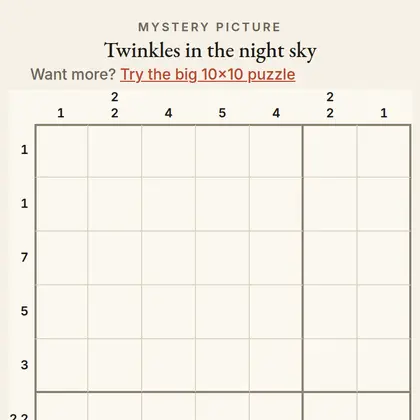
This is the 7x7 puzzle from November 5, 2026, solved one line at a time. Press Next step and the page tells you which technique makes each move.
Want to try it first? Play the November 5, 2026 puzzle in the archive, then come back to check your solve. Archive play does not affect your streak.
The highlighted line is the one being used. New boxes are colored and new crosses are shaded.
Techniques used
The solver was allowed nine named rules and used 4 of them on this puzzle, 2 full sweeps of rows and columns. Each link goes to the lesson.
- completing a line: 8 moves
- simple boxes: 4 moves
- punctuating: 4 moves
- simple spaces: 2 moves
The first moves in words
Nothing is known at the start, so the first moves can only use the clues themselves.
- Row 1 (clue 7) totals 7 boxes, 0 are placed and only 7 squares are open, so none of the open squares can be spared. Fill squares 1 to 7. (Technique: completing a line.)
- Row 2 (clue 1 3 1): the clue needs 7 of 7 squares (1 + 3 + 1 plus 2 gaps), so the slack is 0. A run of 1 and 3 is longer than the slack, so part of it is covered wherever it sits. Fill squares 1, 3 to 5 and 7. (Technique: simple boxes.)
- Row 3 (clue 7) totals 7 boxes, 0 are placed and only 7 squares are open, so none of the open squares can be spared. Fill squares 1 to 7. (Technique: completing a line.)
Every step, written out
Show the full written solve (18 steps)
- Row 1 (clue 7) totals 7 boxes, 0 are placed and only 7 squares are open, so none of the open squares can be spared. Fill squares 1 to 7. (Technique: completing a line.)
- Row 2 (clue 1 3 1): the clue needs 7 of 7 squares (1 + 3 + 1 plus 2 gaps), so the slack is 0. A run of 1 and 3 is longer than the slack, so part of it is covered wherever it sits. Fill squares 1, 3 to 5 and 7. (Technique: simple boxes.)
- Row 3 (clue 7) totals 7 boxes, 0 are placed and only 7 squares are open, so none of the open squares can be spared. Fill squares 1 to 7. (Technique: completing a line.)
- Row 4 (clue 5): the clue needs 5 of 7 squares, so the slack is 2. A run of 5 is longer than the slack, so part of it is covered wherever it sits. Fill squares 3 to 5. (Technique: simple boxes.)
- Column 1 (clue 3) totals 3 boxes and all are already placed, so the line is complete. Cross out squares 4 to 7. (Technique: completing a line.)
- Column 2 (clue 1 3): the run next to square 2 completes the clue at that end of the line, so the square after it is empty. Cross out square 2. (Technique: punctuating.)
- Column 2 (clue 1 3): the clue needs 5 of 7 squares (1 + 3 plus 1 gap), so the slack is 2. A run of 3 is longer than the slack, so part of it is covered wherever it sits. Fill square 5. (Technique: simple boxes.)
- Column 2 (clue 1 3): once finished runs are set aside only the 3 is left, and it must cover squares 3 to 5. It can begin no earlier than square 3 and end no later than square 5, so it can only occupy squares 3 to 5. The squares outside that are out of reach. Cross out squares 6 and 7. (Technique: simple spaces.)
- Column 3 (clue 4 1): the run on squares 1 to 4 is as long as the longest clue (4), so it cannot grow and the squares touching it are empty. Cross out square 5. (Technique: punctuating.)
- Column 4 (clue 7) totals 7 boxes, 4 are placed and only 3 squares are open, so none of the open squares can be spared. Fill squares 5 to 7. (Technique: completing a line.)
- Column 5 (clue 4 1): the run on squares 1 to 4 is as long as the longest clue (4), so it cannot grow and the squares touching it are empty. Cross out square 5. (Technique: punctuating.)
- Column 6 (clue 1 3): the run next to square 2 completes the clue at that end of the line, so the square after it is empty. Cross out square 2. (Technique: punctuating.)
- Column 6 (clue 1 3): the clue needs 5 of 7 squares (1 + 3 plus 1 gap), so the slack is 2. A run of 3 is longer than the slack, so part of it is covered wherever it sits. Fill square 5. (Technique: simple boxes.)
- Column 6 (clue 1 3): once finished runs are set aside only the 3 is left, and it must cover squares 3 to 5. It can begin no earlier than square 3 and end no later than square 5, so it can only occupy squares 3 to 5. The squares outside that are out of reach. Cross out squares 6 and 7. (Technique: simple spaces.)
- Column 7 (clue 3) totals 3 boxes and all are already placed, so the line is complete. Cross out squares 4 to 7. (Technique: completing a line.)
- Row 4 (clue 5) totals 5 boxes, 3 are placed and only 2 squares are open, so none of the open squares can be spared. Fill squares 2 and 6. (Technique: completing a line.)
- Row 6 (clue 3) totals 3 boxes, 1 is placed and only 2 squares are open, so none of the open squares can be spared. Fill squares 3 and 5. (Technique: completing a line.)
- Row 7 (clue 1) totals 1 box and it is already placed, so the line is complete. Cross out squares 3 and 5. (Technique: completing a line.)
GRIDS: daily nonogram
Today's puzzle is waiting. Use what the weekly solve showed you.
Play GRIDSQuestions
Which puzzle is this?
The daily GRIDS puzzle for November 5, 2026, a 7x7 picture of a watermelon. It is already in the archive, so working through it will not give away a puzzle that is still live.
Is every step logic, or did the solver guess?
Every one of the 18 steps is a line deduction that follows from the clue and the squares already known. Nothing is guessed or tried and then undone.
Why does the same technique appear so many times?
Because a puzzle has many lines. Here completing a line accounts for 8 of 18 moves, mostly because it is the quickest way to finish a line.