Simple spaces: cross out squares no block can reach
A block can only stretch so far. Squares beyond its reach, with no other block that could take them, are empty.
Reach
Suppose a line has one clue left, a 3, and a box is already down on square 4. The 3 must cover that box, so it starts somewhere between square 2 and square 4. That makes square 1 impossible and, symmetrically, anything past square 6 impossible. Those squares are out of range of every block, so they are empty.
The word that matters is every. If another clue is still unplaced, the far squares could belong to it, and nothing can be crossed. The technique is clean only when the block you are tracking is the one clue that remains in that stretch.
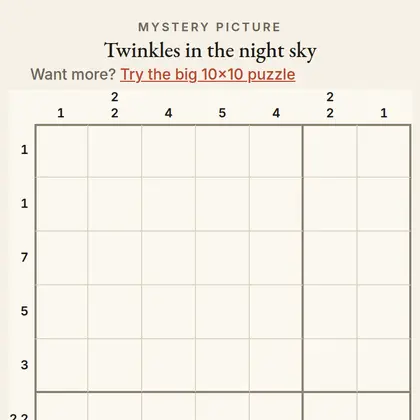
Practice: a 5x5 grid that needs simple spaces
The solver can only continue here by measuring the reach of a block against the squares it must cover.
Swipe the board sideways to see every column.
How we checked this grid: our solver knows nine named rules. With all of them it solves the grid in 17 line moves. With simple spaces switched off it stops with 1 of 25 squares known. The first move that uses simple spaces comes at step 2.
Your marks are saved in this browser, so you can come back to the grid.
Making it clean
Finish what you can first. Punctuate finished blocks at either end, then forget those clues. What remains is often a single clue and a stretch with one box in it, which is exactly the shape this technique needs.
With two boxes known for one clue, the reach shrinks fast. The block must cover both, so it can only wiggle by its length minus the distance between them. Cross out everything outside that window.
The move in three steps
- Find the lone block. Cut away finished blocks at the ends, until one clue is left in the stretch.
- Measure the reach. The block must cover the boxes you have; find how far left and right it can go.
- Cross out beyond it. Everything outside that window is empty.
Worked example: set the finished run aside
A row of twelve has the clue 1 4. There is a box on square 1, which finishes the 1, so square 2 is a cross. Set both aside. A second box sits on square 8.
Only the 4 is left, in squares 3 to 12, and it has to cover square 8. It can start no earlier than square 5 and no later than square 8, so it can only occupy squares 5 to 11. Squares 3, 4 and 12 are out of reach and get crosses.
Common slip. Crossing out squares another unplaced clue could use. Check that only one clue is left in the stretch.
Simple spaces, as Wikipedia describes it
Each link opens the source at the exact sentence.
- This method consists of determining spaces by searching for cells that are out of range of any possible blocks of boxes. sourceWikipedia: Nonogram
- Second, the clue 3 can only spread somewhere between the second cell and the sixth cell, because it always has to include the fourth cell; however, this may leave cells that may not be boxes in any case, i.e. the first and the seventh. sourceWikipedia: Nonogram
- The player must be careful for there may be clues or blocks that are not bound to each other yet. sourceWikipedia: Nonogram
Sources: Wikipedia, Nonogram (revision 1377687149, read 2026-11-01). Wikipedia text available under CC BY-SA 4.0, edited by Wikipedia contributors. The source link after each sentence goes to the passage it comes from.
Keep going
GRIDS: daily nonogram
GRIDS gives you one picture a day. Try the technique on today's puzzle.
Play GRIDSQuestions
How is this different from mercury?
Mercury is the special case where the box sits exactly one block-length from the edge, which kills just the end square. Simple spaces covers any distance and either end.
Can I use it with several clues in a line?
Only after finished clues have been peeled off, or once the order makes clear which block owns which box.