Glue: a box near the edge pins the first clue
A box close to the border has only one run it can belong to. That run is stuck to it, and some of its neighbours are stuck too.
Why a box near the edge is pinned
Take a row of ten with the single clue 5 and a box on square 3. The run of five must cover square 3. Slide it as far left as it goes and it covers 1 to 5. Slide it as far right as it can while still covering square 3 and it covers 3 to 7. Squares 3, 4 and 5 are in both positions, so they are boxes. The glue is square 3 holding the block against the edge.
The condition is simple: the box must be no farther from the border than the length of the first clue. If it is farther than that, the box might belong to the second clue and nothing is certain.
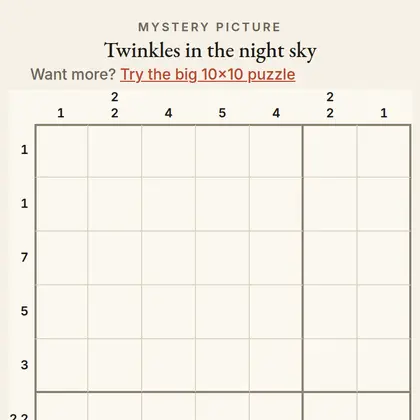
Practice: a 6x6 grid that needs glue
The edge boxes of this grid cannot be reached by plain overlap. Look for a box one or two squares from a border.
Swipe the board sideways to see every column.
How we checked this grid: our solver knows nine named rules. With all of them it solves the grid in 21 line moves. With glue switched off it stops with 15 of 36 squares known. The first move that uses glue comes at step 2.
Your marks are saved in this browser, so you can come back to the grid.
The mirror and the moving wall
Everything works from the other end too, with the last clue. And a crossed-out square can act as a wall. If the first three squares are crossed, treat square 4 as the border, then apply the same rule.
The special case people learn first is a box on the very first square. The first clue starts right there, so you can fill the whole run and, by punctuating, cross out the square after it.
The move in three steps
- Find the first box. Look at the first box from the edge, ignoring crossed squares.
- Check the distance. Is it closer to the border than the first clue is long?
- Fill the shared squares. Fill from that box to the end of the run when pushed against the border.
Worked example: both ends
A row of twelve has the single clue 5 and a box on square 3. On its own that clue has seven squares of slack and fills nothing. But the run has to include square 3. Pushed to the start it covers squares 1 to 5, and the furthest down it can sit while still touching square 3 is squares 3 to 7. Squares 3, 4 and 5 are in both, so they are boxes.
From the far end it works the same way. A line of ten with the clue 2 3 and a box on square 9 pins the last run: it reaches square 7 at the least and square 10 at the most, so squares 8 and 9 are boxes too.
Common slip. Gluing a box to the first clue when the box is farther from the edge than that clue is long. It could be the second run.
Glue, as Wikipedia describes it
Each link opens the source at the exact sentence.
- Sometimes, there is a box near the border that is not farther from the border than the length of the first clue. sourceWikipedia: Nonogram
- In this case, the first clue will spread through that box and will be forced outward from the border. sourceWikipedia: Nonogram
- In the simplest case, whenever a box is present in the first or last cells of a row or column, the first or last clue must be aligned to the edge of that row or column. sourceWikipedia: Nonogram
- It is therefore possible to mark the third, fourth and fifth cell as belonging to the 5. sourceWikipedia: Nonogram
Sources: Wikipedia, Nonogram (revision 1377687149, read 2026-11-01). Wikipedia text available under CC BY-SA 4.0, edited by Wikipedia contributors. The source link after each sentence goes to the passage it comes from.
Keep going
GRIDS: daily nonogram
GRIDS gives you one picture a day. Try the technique on today's puzzle.
Play GRIDSQuestions
Does glue only work at the border?
No. A crossed-out square works as a border, so it works in the middle of a line too, as long as every earlier clue is already finished.
Why is it called glue?
The name is the picture: the box is glued to the border, and the run is dragged outward from the edge with it.