Mercury: a box one clue-length in crosses out the edge
Like mercury pulling back from the sides of a glass, the first run pulls away from the border, and the end square is left empty.
The picture
Say the first clue is 4 and there is a box on square 5, four squares in from the edge. That box has to belong to the first run, because a second run could not start before square 6. A run of 4 that includes square 5 can begin on square 2 at the earliest. If it began on square 1 it would end on square 4 and miss the box, which would then sit hard against the run and make it five long.
So square 1 is never used and can be crossed out. That is the whole technique. It settles a single square, which is why people miss it.
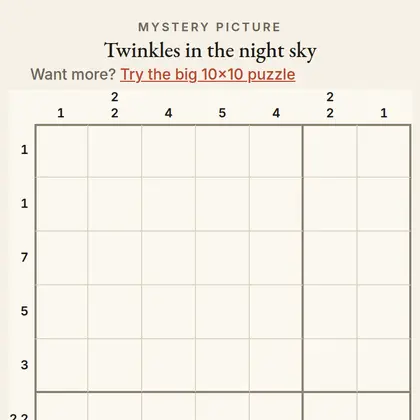
Practice: a 6x6 grid that needs mercury
The grid has a line where the only way in is an end square no run can reach. The solver cannot continue without crossing it out.
Swipe the board sideways to see every column.
How we checked this grid: our solver knows nine named rules. With all of them it solves the grid in 24 line moves. With mercury switched off it stops with 2 of 36 squares known. The first move that uses mercury comes at step 2.
Your marks are saved in this browser, so you can come back to the grid.
More than one square
If the box is really a short run of two or three, the run must cover all of it, which pushes the run further from the border. Each extra box in the run moves the earliest start one square to the right, and one more square at the edge becomes empty.
Check this on every row and column once the first boxes are in. It is quick, and the crosses it makes are at the edge, where they trigger glue and punctuating in the crossing lines.
The move in three steps
- Find the nearest box. Look at the first box from the left or top edge.
- Compare with the first clue. Is the box exactly one clue-length from the edge, or a run that reaches that far?
- Cross out the end. Cross out the end square, and one more for each extra box in that run.
Worked example: one box, then two
In a row of ten with the clue 3 3 and a single box on square 4, the first run of three cannot start on square 1. It would end on square 3, directly beside the box, and the two would fuse into a run of four. So square 1 is empty.
Make it a pair of boxes on squares 4 and 5. The run of three must cover both, so it starts on square 3 at the earliest, and squares 1 and 2 are both empty.
Common slip. Applying it with a later box. The box must be the first one in the line, or the first run may not be the one that owns it.
Mercury, as Wikipedia describes it
Each link opens the source at the exact sentence.
- Mercury is a special case of Simple spaces technique. sourceWikipedia: Nonogram
- Its name comes from the way mercury pulls back from the sides of a container. sourceWikipedia: Nonogram
- If there is a box in a row that is in the same distance from the border as the length of the first clue, the first cell will be a space. sourceWikipedia: Nonogram
- Furthermore, when the box is actually a block of more boxes to the right, there will be more spaces at the beginning of the row, determined by using this method several times. sourceWikipedia: Nonogram
Sources: Wikipedia, Nonogram (revision 1377687149, read 2026-11-01). Wikipedia text available under CC BY-SA 4.0, edited by Wikipedia contributors. The source link after each sentence goes to the passage it comes from.
Keep going
GRIDS: daily nonogram
GRIDS gives you one picture a day. Try the technique on today's puzzle.
Play GRIDSQuestions
Is mercury different from simple spaces?
Wikipedia calls it a special case of simple spaces. We give it its own lesson because it is easy to miss.
Does it work from the right edge?
Yes, mirrored. Use the last clue and the last box.