Forcing: a space in the middle pushes blocks aside
A cross in the middle of a line splits it into rooms. Blocks cannot straddle a cross, so they must squeeze into the rooms that are big enough.
Rooms
Read a line with crosses as a row of rooms separated by walls. A block of 3 needs a room at least 3 wide. A room of width 1 or 2 cannot hold any clue that is 3 or more, so it cannot hold a box and its squares are empty. The smallest clue in the line sets the cut-off: any room narrower than that clue is empty.
With the rooms known, assign the clues in order: the first clue goes in the first room that fits it, then the next clue after it, and so on from the left. Do it again from the right. Where both runs put a clue in the same room, the usual overlap trick applies inside that room.
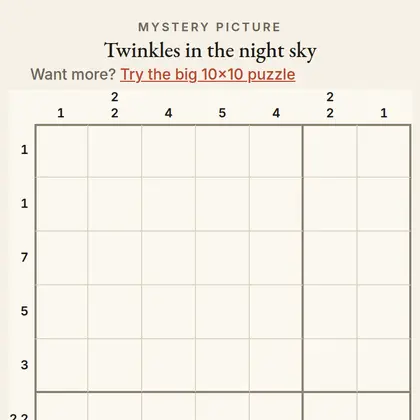
Practice: a 7x7 grid that needs forcing
This grid has a line where a mid-line cross removes every position but one. No other rule opens it.
Swipe the board sideways to see every column.
How we checked this grid: our solver knows nine named rules. With all of them it solves the grid in 24 line moves. With forcing switched off it stops with 28 of 49 squares known. The first move that uses forcing comes at step 9.
Your marks are saved in this browser, so you can come back to the grid.
Worked line
A row of ten with crosses on squares 5 and 7 and the clue 3 2. Rooms: squares 1 to 4, square 6, squares 8 to 10. The 3 needs a room of 3 or more, so it fits in the first or the last room. The 2 comes after the 3 so it has to be in the last room, and the 3 therefore has to be in the first. Square 6 sits in a room too narrow for either clue, so it is empty.
Notice that the cross made no box by itself. It gave the clues fewer places to go, and that is forcing.
The move in three steps
- Mark the rooms. Treat every cross as a wall and list the gaps between walls.
- Cross out small rooms. A room narrower than the smallest clue left cannot hold a box.
- Place clues in order. Assign clues to rooms from the left, then from the right, and take the overlap inside a shared room.
Worked example: two rooms
A row of eleven has the clue 4 3 and crosses on squares 5 and 6. The crosses leave two rooms: squares 1 to 4 and squares 7 to 11. The 3 has to come after the 4, and the second room is only five wide, too small for 4 + 1 + 3. So the 4 goes in the first room, where it fills all four squares.
The 3 goes in the second room, which is five wide. Pushed left it covers squares 7 to 9, pushed right squares 9 to 11, so square 9 is a box. Without the crosses, the same clue settles only square 4.
Common slip. Putting a clue before one it must follow. Clues keep their order along the line, so a later clue cannot be left of an earlier one.
Forcing, as Wikipedia describes it
Each link opens the source at the exact sentence.
- In this method, the significance of the spaces will be shown. sourceWikipedia: Nonogram
- A space placed somewhere in the middle of an uncompleted row may force a large block to one side or the other. sourceWikipedia: Nonogram
- Also, a gap that is too small for any possible block may be filled with spaces. sourceWikipedia: Nonogram
Sources: Wikipedia, Nonogram (revision 1377687149, read 2026-11-01). Wikipedia text available under CC BY-SA 4.0, edited by Wikipedia contributors. The source link after each sentence goes to the passage it comes from.
Keep going
GRIDS: daily nonogram
GRIDS gives you one picture a day. Try the technique on today's puzzle.
Play GRIDSQuestions
Why is forcing listed apart from simple boxes?
Simple boxes assumes nothing is marked. Forcing uses the crosses, so it only exists once some marks are down, which is why punctuating matters.
What if a clue fits in two rooms?
Then it is not forced yet. Wait for more information, or work from the other clues first.