Joining and splitting: decide the gap between two boxes
Two boxes with a single empty square between them force a decision: are they one block or two?
Splitting
When joining the two boxes would make a run bigger than any clue allows, the square between them is empty. In a row with the clue 5 2 2 and boxes on squares 11 and 13, the middle square 12 would join them into a run of three. The 5 is already used up on the left, so only 2s are left for that end of the line, and a run of three fits none of them. Square 12 is crossed out.
Check which clues can still own the joined run, not just the one you expect. If none of them is long enough, it is a split.
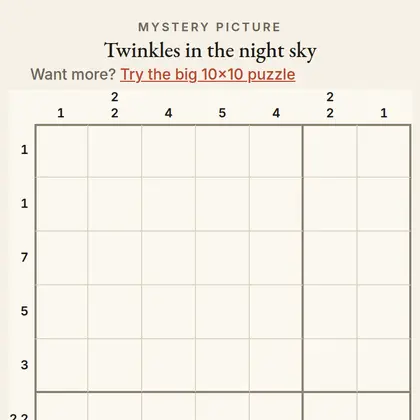
Practice: a 7x7 grid that needs joining and splitting
Look for a line where two boxes are one square apart. The solver cannot finish this grid without deciding such a gap.
Swipe the board sideways to see every column.
How we checked this grid: our solver knows nine named rules. With all of them it solves the grid in 25 line moves. With joining and splitting switched off it stops with 36 of 49 squares known. The first move that uses joining and splitting comes at step 8.
Your marks are saved in this browser, so you can come back to the grid.
Joining
When separating the boxes would leave a block too small for the clue that has to cover them, the square between them is a box. With boxes on squares 3, 4, 6 and 7 and the first clue 5, a gap on square 5 would leave the first run holding squares 3 and 4 with room to stretch left only to square 1. That is four squares at most, one short of the 5. Square 5 is a box.
Both calls are about size. Ask which runs the line still allows, and see whether the joined or the separated version breaks one of them.
The move in three steps
- Find the one-square gap. Look for an unknown square with a box on each side.
- Try joining. Would the joined run be bigger than any clue? Then cross the square.
- Try splitting. Would the two pieces be too small for the clue that must contain them? Then fill the square.
Worked example: a join in a short row
A row of nine has the clue 4 1 and boxes on squares 2 and 4, with square 3 still open. The first run is the 4, and it must hold the box on square 2. A run of 4 that holds square 2 starts on square 1 or 2, so it always reaches square 4. The box on square 4 therefore belongs to the 4 as well.
One run holds squares 2 and 4, so it holds square 3 between them. The gap is joined with a box.
Common slip. Joining boxes that belong to different clues because it looks tidy. Always test the joined size against the clue list.
Joining and splitting, as Wikipedia describes it
Each link opens the source at the exact sentence.
- Boxes closer to each other may be sometimes joined together into one block or split by a space into several blocks. sourceWikipedia: Nonogram
- Note: The illustration picture also shows how the clues of 2 are further completed. sourceWikipedia: Nonogram
- This is, however, not part of the Joining and splitting technique, but the Glue technique described above. sourceWikipedia: Nonogram
Sources: Wikipedia, Nonogram (revision 1377687149, read 2026-11-01). Wikipedia text available under CC BY-SA 4.0, edited by Wikipedia contributors. The source link after each sentence goes to the passage it comes from.
Keep going
GRIDS: daily nonogram
GRIDS gives you one picture a day. Try the technique on today's puzzle.
Play GRIDSQuestions
Can the gap be wider than one square?
The named technique is about the single square. Wider gaps are handled by overlap and forcing.
Does Wikipedia count the completion of the clue as part of this?
No: the article notes that completing blocks in its example belongs to the glue technique, not to joining and splitting.