Cross-referencing: let rows and columns feed each other
Every square sits in a row and a column. What the row learns, the column can use, and the other way round.
The name is ours: Wikipedia describes the idea but does not use it. See the quoted sources below.
The loop
Pick a line and settle everything it can settle. Then look at the lines that cross the squares you just changed. Each new box or cross is a fact about two lines at once, and the second line may have been stuck until now.
The loop is simply: row, column, row, column. A square never stays unknown for lack of cleverness. It stays unknown because the line that could settle it has not yet seen the fact that unlocks it.
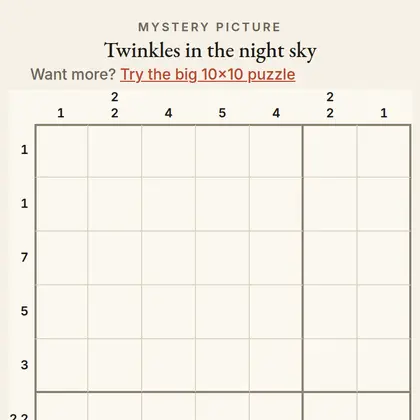
Practice: a 5x5 grid that needs cross-referencing
Try finishing it with rows only, then columns only. You will get stuck both ways, and the solver proves it.
Swipe the board sideways to see every column.
How we checked this grid: working through rows only, the solver stops with 7 of 25 squares known. Columns only stops at 9. Alternating between them solves it in 3 full sweeps.
Your marks are saved in this browser, so you can come back to the grid.
A good order
Start with the biggest clues and with lines that already hold several boxes, because they change the most. After each deduction, go to the crossing lines before you pick a new row. Finish a sweep by checking every line once more, since late crosses often rescue a line that was dull on the first pass.
The practice grid below is chosen so that rows alone never finish it, and neither do columns alone. It takes several full sweeps of rows and columns.
The move in three steps
- Settle one line. Use any technique on a single row or column until it yields nothing more.
- Switch direction. Move to the lines that cross the squares you just changed.
- Sweep again. When you run out, check every line once more, because earlier crosses may have changed it.
Worked example: one fact travels
In a five by five grid, row 3 has the clue 5. It fills the whole row at once. Now every column has a box on its third square.
Every column now has a known box on its third square, which is exactly the kind of fact that glue and mercury need. That is the loop: a result in one row becomes a fact in five columns, and each of those can feed a new row.
Common slip. Staying on one row hoping for more. If a line has stopped yielding, leave it and let the crossing lines change it.
Line-by-line reasoning, as Wikipedia describes it
Each link opens the source at the exact sentence.
- Many nonograms can be solved through line-by-line reasoning, analyzing one row or column at a time before moving to the next and repeating until the grid is complete. sourceWikipedia: Nonogram
- To solve a puzzle, one needs to determine which cells will be boxes and which will be empty. sourceWikipedia: Nonogram
- If guessing is used, a single error can spread over the entire field and completely ruin the solution. sourceWikipedia: Nonogram
Sources: Wikipedia, Nonogram (revision 1377687149, read 2026-11-01). Wikipedia text available under CC BY-SA 4.0, edited by Wikipedia contributors. The source link after each sentence goes to the passage it comes from.
Keep going
GRIDS: daily nonogram
GRIDS gives you one picture a day. Try the technique on today's puzzle.
Play GRIDSQuestions
Does the order of lines matter?
Not for correctness. Any order reaches the same squares, but a good order reaches them with fewer visits.
Is this a technique or just the way the game works?
Both. Wikipedia says that many nonograms can be solved through line-by-line reasoning, one row or column at a time, repeated until the grid is complete.