Contradictions: try a square, and let the grid refute it
When the simple rules are spent, guess in pencil. If the guess breaks a line, you have proved the opposite.
How a try works
Choose an unknown square and assume it is a box. Run every technique you know, on every line, as if the assumption were true. If some line ends up with no legal arrangement, the assumption was impossible, so the square is empty. If nothing breaks, you learn nothing and must rub the pencil out, because the assumption is not proven either.
The reasoning is airtight only when you follow it to a break. A guess that merely looks fine proves nothing, and treating it as true is how errors spread across a grid.
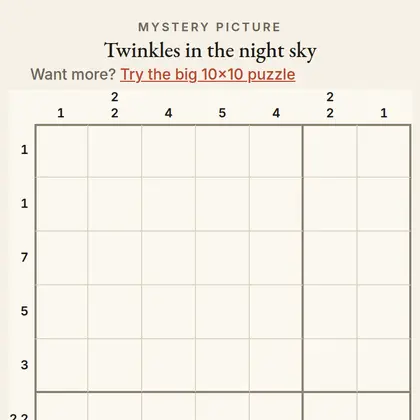
Practice: a 5x5 grid that needs contradictions
On this grid every line rule stalls. The solver needs a single proof by contradiction, and then everything else follows by line logic.
Swipe the board sideways to see every column.
How we checked this grid: line logic alone stops with 17 of 25 squares known. A solver that may also pencil in one square and look for a break then finishes it, using 1 such proof.
Your marks are saved in this browser, so you can come back to the grid.
Choosing a square
Most squares lead nowhere. Good candidates are squares next to many known squares, squares near a border or a block of crosses, and squares in lines that are already mostly filled. Those have the fewest ways out, so a break arrives sooner.
Use a different colour for the assumed squares so you can undo them cleanly. In the practice grid below the solver proves a square this way, and the page shows which line broke.
The move in three steps
- Choose a square. Pick an unknown square with many known neighbours.
- Assume and follow. Pencil in a value and run every technique on every line.
- Look for a break. If a line cannot be satisfied, the opposite value is certain. If not, undo it all.
Worked example: a try that fails
Row 2 has the clue 2 and a box on column 5. Suppose you pencil a box in column 1 of that row. The row now holds boxes in columns 1 and 5, four columns apart, but its only run is two long. That is impossible, so the pencilled box is wrong and column 1 is empty.
Had the pencilled square been column 4, nothing would have broken, and you would have learned nothing from the try.
Common slip. Keeping a guess that did not break anything. No contradiction means no proof, so the pencil marks must go.
Contradictions: what Wikipedia and a 2025 arXiv paper say
Each link opens the source at the exact sentence.
- More difficult puzzles often require additional inference techniques, such as probing: tentatively assuming a value for an uncertain cell and checking whether it leads to a contradiction across more than one row or column. sourceWikipedia: Nonogram
- If a contradiction results, the opposite value can be deduced with certainty. sourceWikipedia: Nonogram
- When all simple methods above are exhausted, searching for contradictions may help. sourceWikipedia: Nonogram
- The problem of this method is that there is no quick way to tell which empty cell to try first. sourceWikipedia: Nonogram
- It has long been known that the problem of deciding if a solution exists is a computationally difficult problem. sourcearXiv: Nonogram: Complexity of Inference and Phase Transition Behavior (Foote and Krizanc, 2025)
Sources: Wikipedia, Nonogram (revision 1377687149, read 2026-11-01); arXiv, Nonogram: Complexity of Inference and Phase Transition Behavior (Foote and Krizanc, 2025) (read 2026-11-07). Wikipedia text available under CC BY-SA 4.0, edited by Wikipedia contributors. The source link after each sentence goes to the passage it comes from.
Keep going
GRIDS: daily nonogram
GRIDS gives you one picture a day. Try the technique on today's puzzle.
Play GRIDSQuestions
Is guessing allowed?
Guessing and keeping the guess is not. Trying a square to disprove it is logic. The difference is whether you commit to a result before it has been proven.
Do all puzzles need this?
No. Wikipedia notes that many nonograms fall to line-by-line reasoning. Contradictions are for the harder ones.