Deeper search: when one proof is not enough
Sometimes one pencil proof opens only a crack. The lines move, stall again, and you need another proof that rests on the first.
Stacking proofs
In a contradiction you assume one square and watch the lines. On harder grids that single proof pays out only a little: the lines move, then stall again. So you pencil the next proof, and this one is allowed to use everything the first one taught you. The practice grid below is built so that line logic alone stops almost at once, and a solver has to chain several proofs one after another to finish it.
The discipline is to finish each proof before you start the next. Write its result in ink, run every line rule again, and only then look for the next square to test. Mixing two unfinished guesses is how a grid gets ruined.
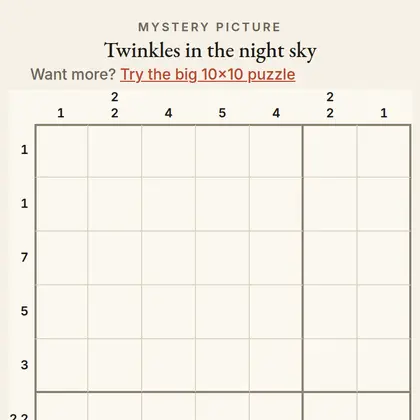
Practice: a 6x6 grid that needs deeper search
Line logic stops almost at once here, and again after every proof. Press "Show the step" whenever it stalls and the page picks the next square to test.
Swipe the board sideways to see every column.
How we checked this grid: line logic alone stops with 4 of 36 squares known. A solver that may pencil a square and look for a break finishes it, but only with a chain of 3 proofs, because the lines stall again after each one.
Your marks are saved in this browser, so you can come back to the grid.
A level down: a try inside a try
The next step is a try inside a try. You assume one square and run the line rules, and nothing breaks. Inside that world you then assume a second square. If that second assumption breaks a line, the second square is refuted, which gives you a new fact inside the first world. A few of those facts together can break a line, and then the first assumption is refuted.
The cost grows fast, and Wikipedia says it is not possible simply by pen and pencil. We went looking for a small grid that needs it. We checked 500,000 distinct 6x6 and 7x7 grids with a solver, including ones picked for being close to ambiguous. None of the grids with exactly one solution needed more than one level of trying. That is a sample of the possible grids, not a proof that none exists.
The move in three steps
- Prove one square. Use a contradiction to settle one square, then finish all the line logic it unlocks.
- Repeat. When the lines stall again, pencil another proof. Each proof may use every square the earlier ones settled.
- Go a level down last. Only if no single try breaks anything, assume a square and try a second one inside it. Expect that in large hand-made grids, not small ones.
Worked example: three proofs in a row
Line logic stops with only a handful of squares known. You test a square, and it breaks a row, so you write the opposite in ink and run the lines again. They move a little, then stall. A second test, which only works because of the first, settles another square. A third finishes the grid. Each proof is small. What makes it a search is that you have to be ready to start another when the last one runs dry.
Now imagine a grid with 60 squares still unknown, where no single test breaks anything. A one-level search would have checked 120 tries. A try inside a try would check each of those and then up to 118 inner tries, about 14,000 checks, each with its own line logic. That is trivial for a program and unthinkable with a pencil.
Common slip. Treating the chain as one big guess. Each proof must be finished, and its result written in ink, before you start the next.
Method note: the 500,000-grid search
In plain words: we made random grids, 6x6 and 7x7, with each square filled with probability between 0.5 and 0.7 (the paper quoted below reports that difficulty depends largely on the density of filled cells, so we varied it). For each grid a solver ran exact line logic, then one level of trying squares. Grids that still stalled were checked for the number of solutions with a backtracking solver. Starting from grids that had two solutions, we also walked single-square changes, up to 40 per start, looking for a grid that became unique while still stalling one level. Every grid was counted once.
- 6x6: 250,000 distinct grids, seed "lesson-deeper-v2-6", 0 unique grids needing more than one level.
- 7x7: 250,000 distinct grids, seed "lesson-deeper-v2-7", 0 unique grids needing more than one level.
The counts above come from one run on 2026-11-07, and the same seeds reproduce them. This is a sample of the possible grids, so it supports "none of these needed it", not "none exists".
Deeper search: what Wikipedia and a 2025 arXiv paper say
Each link opens the source at the exact sentence.
- Some puzzles may require to go deeper with searching for the contradictions. sourceWikipedia: Nonogram
- This is, however, not possible simply by a pen and pencil, because of the many possibilities that must be searched. sourceWikipedia: Nonogram
- In some cases, reasoning over a set of rows may also lead to the next step of the solution even without contradictions and deeper recursion. sourceWikipedia: Nonogram
- However, finding such sets is usually as difficult as finding contradictions. sourceWikipedia: Nonogram
- Our results show that the difficulty of the inference problem is largely determined by the density of filled cells (positive parameters) in a given puzzle. sourcearXiv: Nonogram: Complexity of Inference and Phase Transition Behavior (Foote and Krizanc, 2025)
Sources: Wikipedia, Nonogram (revision 1377687149, read 2026-11-01); arXiv, Nonogram: Complexity of Inference and Phase Transition Behavior (Foote and Krizanc, 2025) (read 2026-11-07). Wikipedia text available under CC BY-SA 4.0, edited by Wikipedia contributors. The source link after each sentence goes to the passage it comes from.
Keep going
GRIDS: daily nonogram
GRIDS gives you one picture a day. Try the technique on today's puzzle.
Play GRIDSQuestions
Will I ever need a try inside a try?
Not in the daily puzzles, which line logic solves. In our search of 500,000 distinct 6x6 and 7x7 grids, none with exactly one solution needed it. Wikipedia says that depth is not possible simply with pen and pencil, because of the many possibilities that must be searched.
Is a chain of proofs the same as guessing?
No. Every proof is finished: the assumed square leads to a break, so its opposite is certain. A guess you keep without a break is exactly what this method rules out.