Simple boxes: fill the overlap of a long clue
A long clue has nowhere to hide. Push it to the left end, push it to the right end, and whatever both positions cover is a box.
How to do it by hand
Take a clue such as 4 3 in a row of ten squares. Pack the runs hard against the left edge, with exactly one empty square between them. Then pack them against the right edge. Compare the two layouts block by block. The first run, the 4, covers squares 1 to 4 in the first layout and squares 3 to 6 in the second, so squares 3 and 4 are covered both times. The 3 covers 6 to 8 and then 8 to 10, so square 8 is shared.
Only overlaps of the same run count. Square 6 is covered by the 4 in one layout and by the 3 in the other, so the shared colour tells you nothing yet. Keep track of which run you are following.
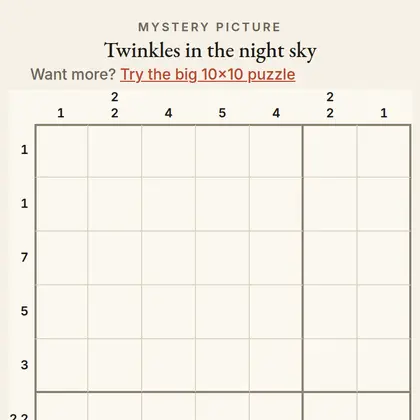
Practice: a 5x5 grid that needs simple boxes
On this grid the solver has no other opening: every first deduction is an overlap. Start with the biggest clues.
Swipe the board sideways to see every column.
How we checked this grid: our solver knows nine named rules. With all of them it solves the grid in 16 line moves. With simple boxes switched off it stops with 0 of 25 squares known. The first move that uses simple boxes comes at step 1.
Your marks are saved in this browser, so you can come back to the grid.
A shortcut for the overlap
You do not have to draw both layouts. Total the clue plus its gaps (4 + 1 + 3 = 8) and subtract from the line length (10 - 8 = 2). That leftover is the slack. A run longer than the slack always has squares in the middle that it cannot avoid: its length minus the slack. The 4 leaves 2 squares, the 3 leaves 1.
Do this to every row and column before you try anything cleverer. On a fresh grid it is usually the only productive move.
The move in three steps
- Pack left. Place every run as far left as it can go, with one empty square between runs.
- Pack right. Place every run as far right as it can go.
- Keep the overlap. For each run, fill the squares it covers in both layouts.
Worked example: two clues
Take eleven squares with the single clue 7. It uses seven, leaving a slack of four, so the run can start anywhere from square 1 to square 5. Whatever it does, it covers squares 5, 6 and 7.
Now a row of eight with the clue 3 3. The clues and their gap use seven squares, slack one. Each 3 is longer than one, so each fills two squares: squares 2 and 3 for the first run, and squares 6 and 7 for the second.
Common slip. Filling squares that two different runs reach. Follow one run at a time through both layouts.
Simple boxes, as Wikipedia describes it
Each link opens the source at the exact sentence.
- At the beginning of the solution, a simple method can be used to determine as many boxes as possible. sourceWikipedia: Nonogram
- This method uses conjunctions of possible places for each block of boxes. sourceWikipedia: Nonogram
- As a result, the block must spread through the six centermost cells in the row. sourceWikipedia: Nonogram
- Consequently, the first block of four boxes definitely includes the third and fourth cells, while the second block of three boxes definitely includes the eighth cell. sourceWikipedia: Nonogram
Sources: Wikipedia, Nonogram (revision 1377687149, read 2026-11-01). Wikipedia text available under CC BY-SA 4.0, edited by Wikipedia contributors. The source link after each sentence goes to the passage it comes from.
Keep going
GRIDS: daily nonogram
GRIDS gives you one picture a day. Try the technique on today's puzzle.
Play GRIDSQuestions
What if no clue is long enough?
Then simple boxes finds nothing in that line yet. Come back after other lines have added crosses or boxes to it.
Is the overlap ever wrong?
No. Every valid arrangement of the clue sits between the two extreme layouts, so a square covered by both extremes is covered by all of them.