Counting the slack: the same overlap on what is left
The overlap trick does not stop after the first pass. Once the ends of a line are settled, run the same count on the part that is still open.
The name is ours: Wikipedia describes the idea but does not use it. See the quoted sources below.
The formula
Add the clue numbers and one gap for each pair of neighbours. Take that from the length of the stretch you are working in. What is left is the slack: how far any run can wiggle. A run bigger than the slack has squares it must cover, and there are exactly run minus slack of them. With the clue 6 2 3 in fifteen squares the total is 13 and the slack is 2. The 6 covers 4 squares, the 3 covers 1, and the 2 covers none.
To place those squares, push all the runs to one side and count through to the run you want. The 6 ends at square 6 when packed left, so its sure squares are 3 to 6.
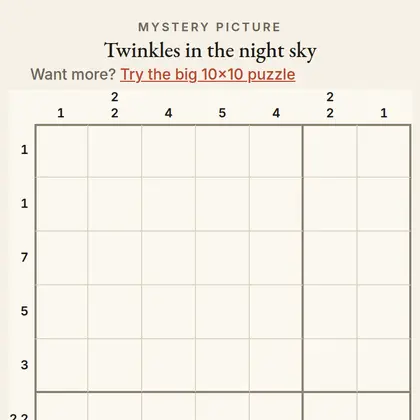
Practice: a 5x5 grid that needs counting the slack
This grid hides its first overlap behind a cross: the slack only turns positive once an end square is closed.
Swipe the board sideways to see every column.
How we checked this grid: our solver knows nine named rules. With all of them it solves the grid in 12 line moves. With counting the slack switched off it stops with 19 of 25 squares known. The first move that uses counting the slack comes at step 8.
Your marks are saved in this browser, so you can come back to the grid.
Run it again later
The useful habit is to run the formula again once a line has changed. A cross at the left end shortens the stretch by one. A finished run at the right end removes both the run and its square from the sum. The slack falls, and runs that were too short to overlap before may now qualify.
This is why a line that gave nothing at the start can pay off ten moves later. Whenever a crossing line adds a cross at either end, recompute that clue first.
The move in three steps
- Trim the line. Ignore crossed squares at either end, and ignore any clue already finished at an end.
- Compute the slack. Clue total plus gaps, subtracted from the length of what is left.
- Fill run minus slack. For each run longer than the slack, fill that many squares, counted from the side you packed against.
Worked example: a row that wakes up
A row of twelve with the clue 4 3 needs eight squares, which leaves a slack of four. Neither run is longer than four, so nothing is filled at the start. Later a column puts a cross on square 12 and another on square 11.
The open stretch is now squares 1 to 10, so the clue needs eight of ten and the slack is two. The 4 is longer than two, so squares 3 and 4 are boxes. The 3 is longer too, so square 8 is a box. The same clue gave nothing, then gave three boxes.
Common slip. Forgetting to remove a finished run from the sum. Leave it in and the slack comes out too small to be right.
The mathematical approach, as Wikipedia describes it
Each link opens the source at the exact sentence.
- It is possible to get a start to a puzzle using a mathematical technique to fill in blocks for rows/columns independent of other rows/columns. sourceWikipedia: Nonogram
- This is a good "first step" and is a mathematical shortcut to techniques described above. sourceWikipedia: Nonogram
- Using this technique for all rows and columns at the start of the puzzle produces a good head start into completing it. sourceWikipedia: Nonogram
- Also, this technique can be used on a smaller scale. sourceWikipedia: Nonogram
Sources: Wikipedia, Nonogram (revision 1377687149, read 2026-11-01). Wikipedia text available under CC BY-SA 4.0, edited by Wikipedia contributors. The source link after each sentence goes to the passage it comes from.
Keep going
GRIDS: daily nonogram
GRIDS gives you one picture a day. Try the technique on today's puzzle.
Play GRIDSQuestions
How is this different from simple boxes?
Same arithmetic, smaller line. Simple boxes works on the whole line before anything is known. Counting the slack works on what is left after crosses and finished runs.
What if the slack is zero?
Then the clue fills the stretch exactly, with no choice at all. Every run is placed.