Completing a line: when the count settles the rest
Some lines are done before you notice. Add up the clue, count what you have, and the leftovers answer themselves.
The name is ours: Wikipedia describes the idea but does not use it. See the quoted sources below.
The count that closes a line
Add the numbers in a clue. A clue of 2 1 totals three boxes, no matter how the runs sit. Now count the boxes you have already found in that line. If the two totals match, every other square is empty and can be crossed out in one sweep.
The same count works from the other side. Count the squares that are still open, add the boxes already placed, and compare with the clue total. If the open squares plus the placed boxes only just reach the total, nothing can be spared and every open square is a box.
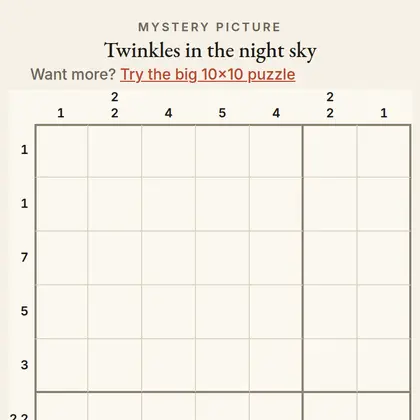
Practice: a 7x7 grid that needs completing a line
This grid is chosen so that the solver runs out of other rules without a counting step. Look for a line where you have just placed its last box.
Swipe the board sideways to see every column.
How we checked this grid: our solver knows nine named rules. With all of them it solves the grid in 13 line moves. With completing a line switched off it stops with 47 of 49 squares known. The first move that uses completing a line comes at step 1.
Your marks are saved in this browser, so you can come back to the grid.
Why it matters more than it looks
Crossed-out squares are how rows hand information to columns. A row that was only half understood becomes a row of known squares, and each column that crosses it gets a free fact. Lines that look unfinished are often one count away from done, so make the count a habit whenever you place a box.
Beginners tend to count only at the very end, when the picture is almost there. Count as you go instead. It costs a second, and it is the cheapest deduction in the whole game.
The move in three steps
- Add the clue. Total the numbers in the row or column clue. A clue of 0 is a total of zero.
- Count what you have. Count the boxes already placed in that line.
- Compare. If you have the whole total, cross out every open square. If open squares plus placed boxes equal the total, fill every open square.
Worked example: a column of eight
A column of eight squares has the clue 3 2. You have already marked boxes on squares 1, 2 and 3 and on squares 6 and 7. That is five boxes, and 3 + 2 is five. The count is complete, so squares 4, 5 and 8 get crosses and the column is finished without any more thinking.
Now flip it. A row of five has the clue 2 1 and crosses on squares 3 and 5. Three squares remain open and the clue needs three boxes, so squares 1, 2 and 4 are all boxes.
Common slip. Counting crossed squares as boxes. Only filled squares count toward the total, and a cross never does.
What the reference says about clues and marking squares
Each link opens the source at the exact sentence.
- In this puzzle, the numbers are a form of discrete tomography that measures how many unbroken lines of filled-in squares there are in any given row or column. sourceWikipedia: Nonogram
- Solvers often use a dot or a cross to mark cells they are certain are spaces. sourceWikipedia: Nonogram
- Cells that can be determined by logic should be filled. sourceWikipedia: Nonogram
Sources: Wikipedia, Nonogram (revision 1377687149, read 2026-11-01). Wikipedia text available under CC BY-SA 4.0, edited by Wikipedia contributors. The source link after each sentence goes to the passage it comes from.
Keep going
GRIDS: daily nonogram
GRIDS gives you one picture a day. Try the technique on today's puzzle.
Play GRIDSQuestions
Does a clue of 0 count as completing a line?
Yes. The total is zero, so there is nothing to fill and every square in that line is empty.
Is this a real technique or just common sense?
It is common sense, written down. The named techniques in Wikipedia build on it, and our solver treats it as its own rule so you can see when it is the only thing that works.