Fool's mate in two moves
Fool's mate is the shortest possible checkmate: two moves by Black after White opens badly. Watch it, deliver it as Black, and learn what White should play instead.
Fool's mate explained
White plays 1. f3 or 1. g4 and then the other, which opens the diagonal from h4 to the white king. Black replies 1... e5 and 2... Qh4#.
You will almost never see it in a real game, but it teaches an important lesson: the f- and g-pawns shield the king, and moving both early is dangerous.
Why does it work?
Moving both the f-pawn and g-pawn opens the h4-e1 diagonal. The white king on e1 has no piece to block, and the queen mates on h4.
Can White do something similar?
Not in two moves. White needs at least three: 1. e4 g5 2. d4 f6 3. Qh5#, and it only works if Black plays very badly. The scholar's mate is the more common trap, at four moves.
How do I avoid it?
Do not push both the f- and g-pawns in the opening.
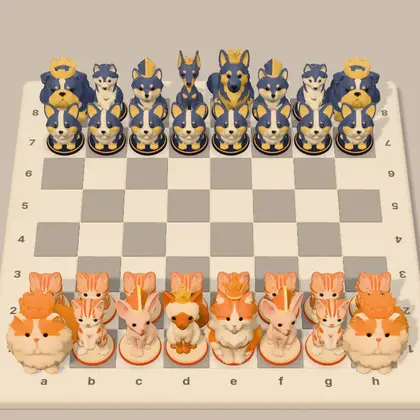
Cats vs Dogs Chess: 3d chess with cats and dogs
Cats vs Dogs Chess is a 3D chess game with five computer levels and a pass-the-phone mode. Free in your browser.
Play Cats vs Dogs ChessPractice puzzles
Keep learning
Questions
Is it really possible in two moves?
Yes, and it is the shortest checkmate in chess. It needs White to play 1. f3 or 1. g4 followed by the other pawn.
Is fool's mate the same as scholar's mate?
No. Fool's mate takes two moves and needs White to play badly. Scholar's mate takes four and is a trap White sets for Black.
Has it happened in master games?
Very rarely, if ever. Strong players do not move both pawns in front of the king that early.