Mate in 1 puzzles
In each puzzle one move ends the game: a checkmate.
About mate in 1 puzzles
In each puzzle one move ends the game: a checkmate. These are the first puzzles to learn from, because every checkmate you recognize in one move becomes the last move of a longer plan.
How to spot it
- List every check you have. Most mate-in-1 puzzles are one of them.
- For each check, ask: can the king capture the checking piece, step away, or can another piece block?
- Look at squares next to the king. If your own pieces or the edge of the board cover them, the king has nowhere to go.
A common mistake
Playing the first check you see. A check that the king can capture or step out of is not mate; test all three escapes.
A worked example
 K
 R
 BR
 N
 N
 Q
 Q
 B
 N
 R
 KR
Black to move. White has just played Qxg4. Find the checkmate.
Solution: 13... Qxh2#
Qxh2# attacks the pawn on g2. The last move is checkmate: the king has no safe square and nothing can block or capture.
The highlighted squares show White's last move. This position is a different puzzle from the ones you start with above (1195 rating).
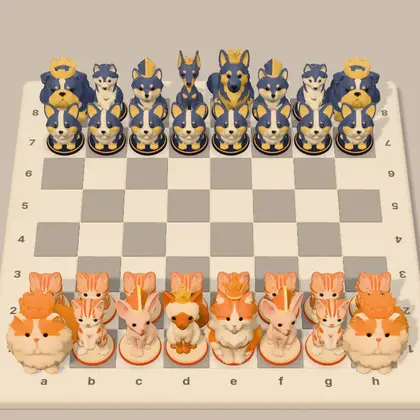
Cats vs Dogs Chess: 3d chess with cats and dogs
Cats vs Dogs Chess is a 3D chess game with five computer levels, a pass-the-phone mode and a daily mate puzzle. Free in your browser.
Play Cats vs Dogs ChessMore chess puzzles
New to chess? See how each piece moves or play chess against the computer.
Questions
How do I find mate in one?
Look at every check you can give. A checkmate is a check where the king cannot capture the checker, move away or block. Test each check against those three escapes.
Where do these puzzles come from?
They are real puzzles from the Lichess puzzle database, which is free to use under the CC0 license. Each one was built from a real game and tested by many players. We picked well-rated ones with good popularity scores.
Are the puzzles free?
Yes. There is no signup, no limit and no ads on the puzzles. Your progress on this page is not saved after you leave.
What do the difficulty levels mean?
Beginner puzzles are rated under 1250, intermediate 1250 to 1749 and advanced 1750 and up, using the rating Lichess players earned on each puzzle.