Mate in 2 puzzles
You move, your opponent replies, and your second move is checkmate.
About mate in 2 puzzles
You move, your opponent replies, and your second move is checkmate. The first move is usually a check, a threat, or a sacrifice that forces the reply.
How to spot it
- Look for a forcing first move: a check, or a threat of mate that your opponent has only one defence against.
- Count the squares the enemy king can use after your first move. If it has one, the second move will usually cover it.
- Quiet first moves are common. When no check works, look for a move that takes away the last flight square.
A common mistake
Looking only at checks. Many mate-in-2 puzzles start with a quiet move or a sacrifice that leaves no defense.
A worked example
 K
 B
 Q
 Q
 K
 N
Black to move. White has just played Qxa1. Find the checkmate in 2.
Solution: 39... Nxf3+ 40. Kh1 Qxh2#
Nxf3+ checks the king and also attacks the pawn on h2, so your opponent has to answer the check. The last move is checkmate: the king has no safe square and nothing can block or capture.
The highlighted squares show White's last move. This position is a different puzzle from the ones you start with above (954 rating).
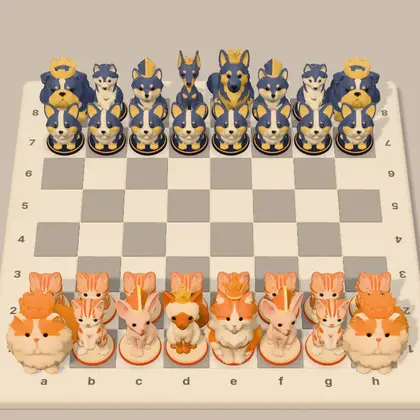
Cats vs Dogs Chess: 3d chess with cats and dogs
Cats vs Dogs Chess is a 3D chess game with five computer levels, a pass-the-phone mode and a daily mate puzzle. Free in your browser.
Play Cats vs Dogs ChessMore chess puzzles
New to chess? See how each piece moves or play chess against the computer.
Questions
What is the trick to mate in two?
Find the last move first. Picture the checkmate position, then look for a first move that forces your opponent into it or leaves only replies that allow it.
Where do these puzzles come from?
They are real puzzles from the Lichess puzzle database, which is free to use under the CC0 license. Each one was built from a real game and tested by many players. We picked well-rated ones with good popularity scores.
Are the puzzles free?
Yes. There is no signup, no limit and no ads on the puzzles. Your progress on this page is not saved after you leave.
What do the difficulty levels mean?
Beginner puzzles are rated under 1250, intermediate 1250 to 1749 and advanced 1750 and up, using the rating Lichess players earned on each puzzle.