Chess rules
Chess rules for beginners
The goal is checkmate. Everything else is how the pieces move and a few special moves. Try things on the board below, then open a rule for a hands-on lesson.
Tap a piece to see where it can go, then tap a square to move. You play both sides.
Rule lessons
En passant4 practice boardsCastling3 practice boardsPawn promotion3 practice boardsCheck, checkmate and stalemate3 practice boardsScholar's mate3 practice boardsFool's mate3 practice boardsLegal's mate4 practice boardsHow the pieces moveOne lesson per pieceBoard setupPlace all 32 piecesChess notationRead and write moves
How a game ends
- Checkmate. The king is attacked and has no escape. The game is over and that player wins.
- Resignation. A player gives up. This is common in real games when the position is lost.
- Stalemate. The player to move has no legal move and is not in check. A draw.
- Repetition. If the same position appears three times, either player can claim a draw.
- Fifty-move rule. If fifty moves pass with no pawn move and no capture, either player can claim a draw.
- Not enough pieces. A king alone against a king and a knight, for example, cannot checkmate, so the game is a draw.
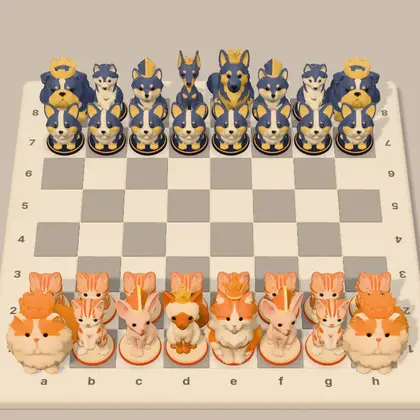
Play a real game
Cats vs Dogs Chess: 3d chess with cats and dogs
Start on Kitten level and learn by playing. Hints show where each piece can go.
Play Cats vs Dogs ChessQuestions
What is the goal of chess?
To checkmate the other player's king: attack it so that it cannot escape capture. You win by checkmate, or when your opponent resigns.
Who moves first?
White always moves first, then the players take turns, one move each.
What are the special rules in chess?
Castling, en passant and pawn promotion. Each lets a move happen that does not follow the usual piece rules.
How can a chess game end in a draw?
By stalemate, by agreement, by threefold repetition of a position, by the fifty-move rule, or when neither side has enough pieces to checkmate.