How to solve a word search faster
Most people scan the grid hoping to spot a word. These eight habits find words quicker. Try them on the practice puzzle below: its word list is made of the tips themselves.
10 by 10, words across, down, diagonal and one backward. Drag across a word, or tap its first and last letter.
Find these words
- ANCHOR
- EYES
- FIRST
- GRID
- LAST
- LETTER
- LIST
- RARE
- ROW
- SCAN
Eight tips that work
- Start with the rarest letter. If a word has a Q, Z, X, J or K, find that letter first. A Q appears only a few times in a grid, so you can check every one in seconds.
- Look for one letter, not the whole word. Your eye can hold one shape at a time. Pick the first letter of a word and sweep the grid for it.
- Check all eight directions from every match. Up, down, left, right and the four diagonals. People miss words because they only check across and down.
- Search for word shapes. Double letters such as LL and EE, and pairs like TH, QU, CK and PH, stand out faster than single letters.
- Circle lightly. Words cross. If you press hard you will not see the shared letter when you look for the next word.
- Work the list longest first. Long words have fewer places to hide, and finding them also fills in letters that help with the short ones.
- Scan backward on purpose. Read each row right to left once. Your brain reads forward by habit, so backward words slip past.
- Leave the short words for last. A three-letter word will often show up while you are looking for something else.
Practice on a theme you like
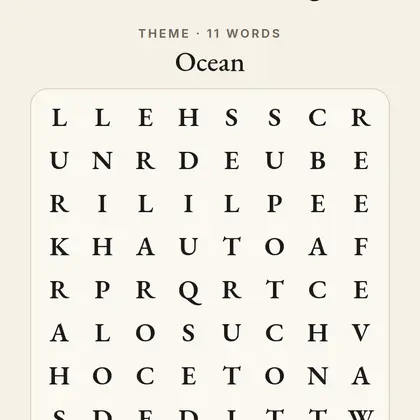
SEEK: word search with a hidden word
SEEK gives you one 8 by 8 word search each day. The leftover letters spell a hidden word, so you cannot skip a word.
Play SEEKKeep going
Questions
What is the fastest way to solve a word search?
Scan the grid for the first letter of one word at a time, then check the eight directions around each match. Start with words that have a rare letter such as Q, Z, X or K, because there are few places they can be.
Should I search for words in order?
No. Work the list by difficulty, not by order. Long words and words with rare letters first, short common words last, since short words are the ones you will find by accident.
Why can I not find the last word?
Usually it runs backward or diagonally, or it shares letters with a word you already circled. Look at the rows and columns you scanned fastest, and check for the word reading right to left.
Do word searches help your brain?
They give your eyes and memory a light workout in pattern matching. They are an enjoyable way to pass ten minutes, not a medical treatment.